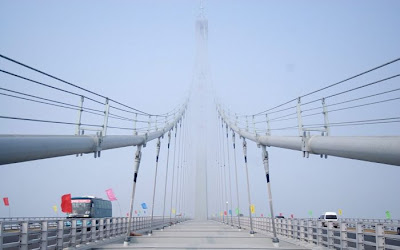
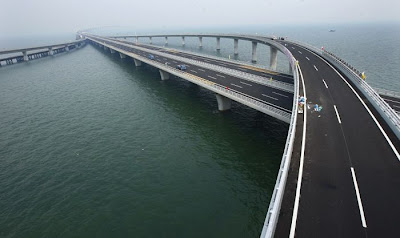
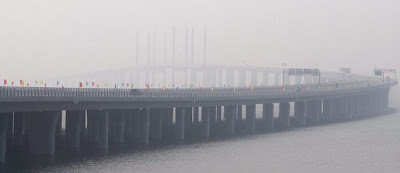
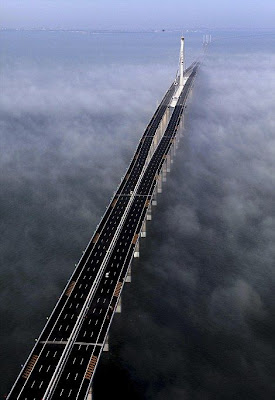
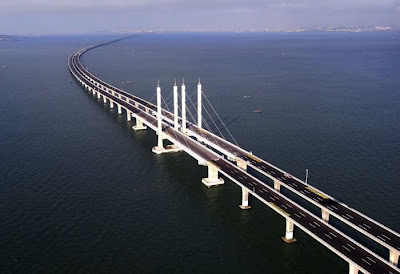
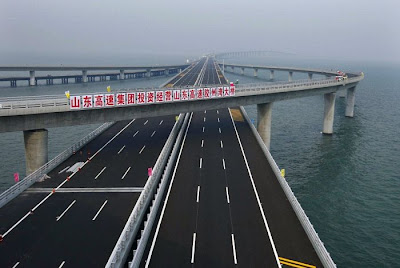
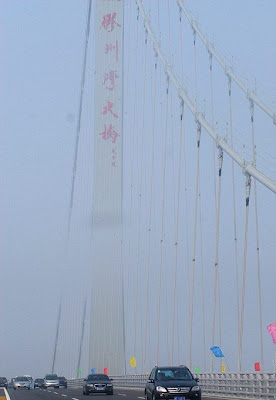
The Qingdao Haiwan Bridge, completed earlier this week, links the main urban area of Qingdao city, East China’s Shandong province, with Huangdao district, straddling the Jiaozhou Bay sea areas.
The road bridge, which took four years and cost a cool £5.5billion to build, will be open for use in the New Year and is almost three miles longer than the previous record-holder, the Lake Pontchartrain Causeway in Louisiana.
Showing posts with label Buildings and Architecture. Show all posts
Showing posts with label Buildings and Architecture. Show all posts
Saturday, July 2, 2011
China Opens World's Longest Sea Bridge
China has unveiled the world’s longest sea bridge, which stretches a massive 26.4 miles – five miles further than the distance between Dover and Calais and longer than a marathon.

Thursday, June 30, 2011
China Opens World's Longest Sea Bridge
China has unveiled the world’s longest sea bridge, which stretches a massive 26.4 miles – five miles further than the distance between Dover and Calais and longer than a marathon.
The Qingdao Haiwan Bridge, completed earlier this week, links the main urban area of Qingdao city, East China’s Shandong province, with Huangdao district, straddling the Jiaozhou Bay sea areas.
The road bridge, which took four years and cost a cool £5.5billion to build, will be open for use in the New Year and is almost three miles longer than the previous record-holder, the Lake Pontchartrain Causeway in Louisiana.







Source: dailymail
The Qingdao Haiwan Bridge, completed earlier this week, links the main urban area of Qingdao city, East China’s Shandong province, with Huangdao district, straddling the Jiaozhou Bay sea areas.
The road bridge, which took four years and cost a cool £5.5billion to build, will be open for use in the New Year and is almost three miles longer than the previous record-holder, the Lake Pontchartrain Causeway in Louisiana.


Source: dailymail
Thursday, April 14, 2011
The Largest Mud Brick Building in the World
The Great Mosque of Djenné, Mali a World Heritage Site is the World's Largest Mud-brick Building. It was built around 1908, though a mosque existed at this site from early 13th century. Like the earlier mosque this mosque is also made entirely of mud-brick, mud mortar and mud based plaster. The covered hall is about 50 x 24 metres.
Although not very well known, but after the Sphinx and Pyramids, it is one of the most famous land marks in Africa. Its popularity can be gauged by the fact that two buildings across the world are its replica. More image over here.

Although not very well known, but after the Sphinx and Pyramids, it is one of the most famous land marks in Africa. Its popularity can be gauged by the fact that two buildings across the world are its replica. More image over here.
Wednesday, April 13, 2011
The Mirrorcube - Tree Hotel In Sweden
Talk about blending in with nature, the Mirror Cube Tree Hotel in Sweden certainly does! This hotel is literally a “tree house” that is completely covered in mirror so it can reflect its surroundings.
It’s a 4m by 4m by 4m aluminium cube covered in mirrored glass hung round a tree trunk. Once it’s in place, it simply disappears into the forest. The panoramic views from the windows must be absolutely stunning.
Designed by Tham & Videgård Arkitekter, the cube is a treehouse for two people, with room for a kitchenette, bathroom, bedroom and roof terrace. None of the pictures show how you actually get into the cube but rope ladders and bridges are mentioned in the blurb.


Saturday, April 9, 2011
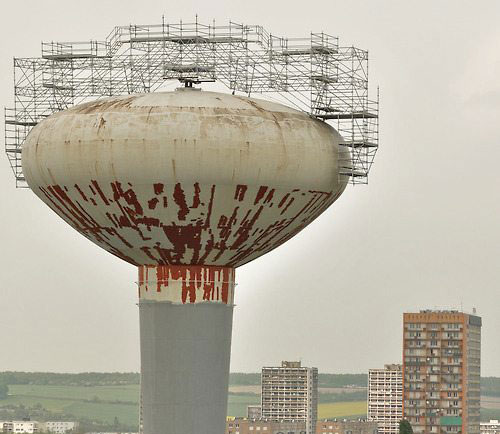
Crazy Scaffolding
From a distance, scaffolding looks like a maze of criss-crossing steel pipes that encircles a building. But peer closely and you will realize that complex and precision engineering is at work behind the lattice.
It is believed that scaffolding originated in ancient North Africa and China. A Greek wine cup, also known as a kylix and dating back to the fifth century, contains an image of a statue of a warrior within a scaffolding.
Scaffolding today is mainly made of metal pipes. But in some parts of Asia, scaffolding is made of bamboo and is even used when building very tall skyscrapers.
This is extreme scaffolding, but to most scaffolders it is just another day at the office.


Subscribe to:
Posts (Atom)


